Fifty Experiments in Endurance: What State Constitutions Reveal About Governance After a Federal Catastrophe

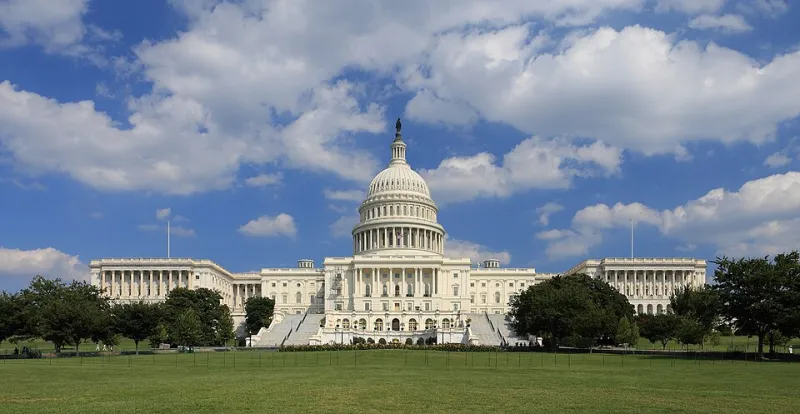
Photo: Photograph: Radomianin, Public domain, via Wikimedia Commons
The Overlooked Second Line of Defense
Discussions of continuity in American government almost always gravitate toward Washington: the presidential line of succession, the Twenty-Fifth Amendment, the designated survivor at the State of the Union. Yet if a catastrophic event — a nuclear strike on the capital, a coordinated attack on federal institutions, a prolonged disruption of federal authority — ever rendered the national government inoperable, the first institutions capable of restoring order would not be in the District of Columbia. They would be in the fifty state capitals.
Every state constitution contains provisions governing succession to the governorship, emergency powers, and the reconstitution of legislatures. These clauses, largely drafted in the nineteenth and twentieth centuries and rarely litigated, form an untested second line of defense for the American constitutional order. How well they would perform is a question policymakers have mostly declined to ask.
A Patchwork of Preparation
No two states approach continuity identically. New York's constitution empowers its legislature to establish an immediate temporary succession to the governorship, a provision born of Cold War-era anxieties and later refined after September 11. California, by contrast, provides an unusually detailed statutory chain that extends deep into its executive branch, naming successors down to the state controller and treasurer.
Some states have gone further than others. New Jersey's constitution requires the legislature to convene within days of an executive vacancy to confirm a successor, building in a check on unilateral power grabs. Colorado and Florida have invested in permanent continuity-of-government commissions that conduct regular exercises, treating succession planning as an ongoing discipline rather than a dusty legal footnote. Several states maintain designated-successor arrangements for legislative leadership, ensuring that a decapitated legislature can still achieve quorum and pass emergency measures.
At the other end of the spectrum sit states whose provisions are strikingly thin. A handful of constitutions address gubernatorial succession in a single sentence, leaving unresolved questions about what happens when both the governor and lieutenant governor are incapacitated. A few states have no codified plan for reconstituting a legislature that cannot achieve quorum — a scenario that would paralyze lawmaking precisely when it matters most.
The Constitutional Design Questions That Remain Open
Three structural weaknesses recur across state frameworks.
First, most plans assume a localized disaster. They contemplate the death or incapacity of a single governor, not the simultaneous loss of leaders across multiple states. A regional catastrophe — an earthquake along the Cascadia fault, a pandemic that sweeps the country — would test provisions designed for isolated vacancies.
Second, the interplay between state emergency powers and federal authority is poorly mapped. Governors hold sweeping powers under their own constitutions to suspend statutes, seize property, and command the militia during emergencies. But what happens when federal authority itself is the thing that fails? The Supreme Court has never squarely addressed the extent to which state governments may carry on national functions during a federal vacuum, and the academic literature on the subject remains sparse.
Third, succession chains frequently terminate too early. Many state lists run only two or three names deep. Modern continuity doctrine, as reflected in federal practice since the 1947 Presidential Succession Act, favors longer, more redundant chains that account for the possibility that multiple officeholders are affected by the same event.
Toward a Harmonized National Framework
The solution is not to impose uniformity from above — the federal system's diversity is itself a resilience asset. But a baseline of interoperability would serve the country well.
A sensible agenda would include: minimum standards for succession chain length in every state; mandatory continuity exercises conducted jointly with neighboring states and federal agencies; constitutional or statutory clarity on legislative reconstitution when quorum fails; and interstate compacts that establish mutual recognition of emergency authorities when adjacent states are simultaneously compromised.
The National Governors Association and the Council of State Governments have taken preliminary steps in this direction, but participation remains voluntary and uneven. Congress could accelerate the process by conditioning certain federal emergency-management grants on the adoption of verified continuity plans, much as it did with hazard mitigation standards in the 1990s.
Resilience Is a Habit, Not a Document
The deeper lesson of comparative state practice is that paper provisions are necessary but insufficient. Florida's framework works not because its text is elegant but because it is exercised. Continuity planning, like emergency medicine, degrades without rehearsal.
The American republic has survived civil war, economic collapse, and foreign attack in no small part because power in this country is distributed rather than concentrated. The fifty state constitutions are the quiet embodiment of that principle. Treating them as living instruments of national resilience — tested, harmonized, and periodically rehearsed — is among the least expensive and most consequential insurance policies the nation can purchase.
The time to read the fine print is before the lights go out.