The One-Vote Rule: Contingency Planning for a Contingent Election
The 12th Amendment is often treated as a constitutional footnote, a relic of the 1800 election that surfaces in civics textbooks and then recedes. In practice, it is a live contingency plan: if no presidential candidate receives a majority of Electoral College votes, the election moves to the House of Representatives, where each state delegation casts one vote. That is not a metaphor. It is a literal one-vote-per-state ballot, and it creates a set of planning obligations that receive far less attention than they deserve.
The Machinery, Briefly Stated
Under the 12th Amendment, the House chooses the President from the top three electoral vote recipients. Voting is by state delegation, not by individual member, and a majority of states is required to win. The Senate, meanwhile, chooses the Vice President from the top two electoral vote recipients, with each senator voting individually. The House contingent election requires a quorum of two-thirds of the states, and the proceedings are governed by a mix of constitutional text, House rules, and practices that are not always obvious to the public.
The essential point is that the contingent election is not a free-form negotiation. It is a structured constitutional event with a fixed electorate: state delegations. If a catastrophe disrupts those delegations, the structure does not simply bend. It strains.
Where the Planning Gap Begins
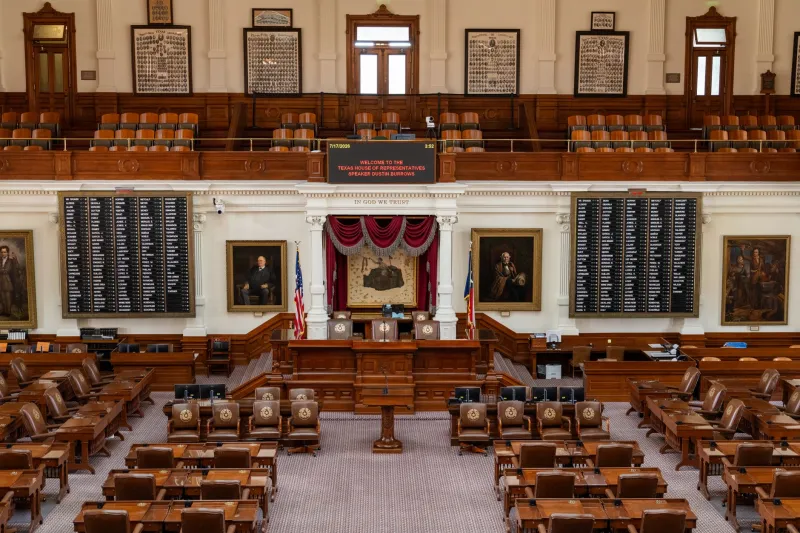
The most visible continuity planning for Congress focuses on the physical institution: relocation, secure communications, quorum, and the capacity to legislate. Those are necessary. They are not sufficient for a contingent election. A contingent election depends on the composition and internal organization of each state delegation, and House vacancies cannot be filled by appointment in the way Senate vacancies often can. If a disaster kills or incapacitates members before a contingent election, the affected states may have fewer voting members, uneven representation, or no clear internal process for casting their one vote.
This is not a hypothetical concern invented for a planning exercise. The House has experience with disruption, from the British burning of the Capitol in 1814 to the emergency adjustments after September 11, 2001, and the pandemic-era changes of 2020. Each episode exposed friction between the institution’s formal rules and the practical need to keep operating. A contingent election would concentrate that friction into a single, high-stakes proceeding.
Delegation Rules Are Not Uniform
A state delegation’s one vote is cast according to procedures that are partly internal to the House and partly shaped by delegation practice. When a delegation is evenly divided, the practical result can be that the state does not cast a vote at all, which affects the majority threshold. When a delegation loses members unexpectedly, the remaining members may disagree about who is authorized to speak for the state. When a state’s delegation is large and geographically dispersed, emergency relocation can make even a simple caucus meeting difficult.
These are not abstractions. They are the kind of procedural questions that would need answers under time pressure, with the country watching and the legitimacy of the outcome at stake. A public legibility standard would require the House to publish, in advance, how each delegation would organize itself for a contingent election, how vacancies and incapacities would be handled, and how ties would be resolved. That standard would not dictate outcomes. It would make the process understandable before it is tested.
The Certification Layer
The contingent election is connected to the Electoral College certification process, and the connection matters. The joint session of Congress on January 6 is the point at which electoral votes are counted and objections are resolved. If no candidate reaches a majority, the House moves to the contingent election. But the transition between those stages depends on clear congressional procedures and on the capacity of the joint session to complete its work.
A catastrophe that disrupts Congress before or during certification could create competing pressures: to delay, to relocate, to reconstruct quorum, or to proceed under emergency rules. Continuity planning should address those pressures directly, including the sequence of authority for presiding officers, the availability of secure locations, and the communications protocol for informing states and the public about the status of the count.
A Rehearsal Standard
The strongest argument for rehearsal is not that a contingent election is likely. It is that the process is complex, constitutional, and dependent on human organization under stress. A rehearsal standard would require a simulated contingent election before each presidential cycle, conducted with the same seriousness as a continuity-of-government exercise. It would test delegation caucuses, quorum calls, communications, and the handoff from certification to contingent voting. It would also produce a public after-action report, because public confidence in a contingent election depends on public understanding of how it works.
The 12th Amendment does not need to be rewritten. It needs to be read as a continuity provision, not a historical curiosity. The country has spent two decades improving the resilience of the physical machinery of government. The next step is to extend that work to the constitutional machinery that would decide a presidency when the Electoral College does not.