Five Quorums, Five Fractures: Where Independent Commissions Break Under Stress
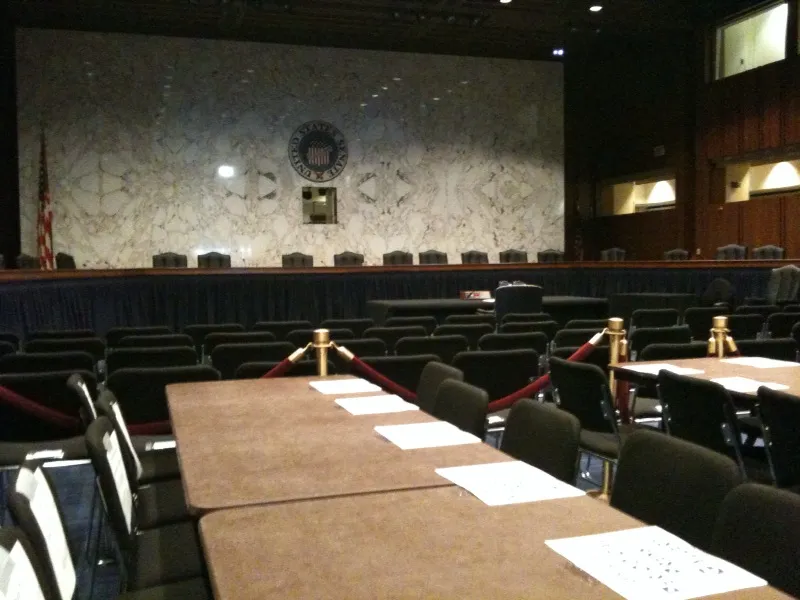
Photo: Jay Tamboli, CC BY 2.0, via Wikimedia Commons
Quorum requirements are the load-bearing walls of independent agencies, and most Americans have never heard of them. They are also the places where a single catastrophe—a bombing, a biological event, a coordinated attack on a confirmation calendar—could halt enforcement, freeze rulemaking, and leave markets and workplaces without a referee.
The pattern is consistent across the regulatory state. Congress creates a five-member bipartisan commission, sets a majority as the quorum, and assumes confirmations will keep pace. In ordinary times, they mostly do. In a crisis, the assumption fails in about the time it takes to read a news alert.
Five bodies illustrate the fragility, each in a slightly different way.
1. The Federal Trade Commission: The Merger Clock Stops
The FTC operates with five commissioners, no more than three from the same party, and requires a majority for official action. Two simultaneous vacancies—entirely plausible if a single event strikes a hearing room or a confirmation hearing—leave the agency unable to authorize litigation, accept consent orders, or issue second requests in merger review.
The fix: a statutory emergency quorum of two, narrowly limited to (a) accepting or declining consent orders already negotiated, (b) authorizing routine filings, and (c) extending statutory deadlines so that private parties are not penalized for the government's incapacity. The authority should expire after ninety days unless renewed by Congress, and every action taken under it should be logged publicly.
2. The Securities and Exchange Commission: Rulemaking in a Downdraft
The SEC's five commissioners, with a three-member quorum, oversee an institution whose usefulness depends on speed. Emergency exemptive relief, trading halts, and temporary rule adjustments are exactly the kind of decisions that cannot wait for a confirmation cycle.
The fix: codify a pre-delegation of time-critical exemptive authority to a named group of senior staff—the General Counsel, the Director of the Division of Trading and Markets, and one commissioner—with mandatory ratification within seventy-two hours of a quorum being restored. Delegations of this kind already exist in narrower form; the failure is the absence of a statutorily anchored emergency channel with a ratification clock.
3. The Federal Energy Regulatory Commission: The Grid Does Not Wait
FERC's five commissioners, with a three-member quorum, sit atop a jurisdiction where delay is measured in megawatts. Pipeline certificates, reliability waivers, and emergency orders during a regional grid event cannot queue behind a Senate calendar.
The fix: a statutory emergency-delegation clause permitting the General Counsel and the relevant program director to issue temporary orders of no more than thirty days' duration during a declared grid emergency, subject to ratification at the first quorum-capable meeting. Coupled with this, Congress should require FERC to publish a quorum continuity annex identifying which functions are delegable, which are not, and why.
4. The National Labor Relations Board: The Lesson Already Learned
The Board's five members, with a three-member quorum for adjudication, produced the clearest warning in modern administrative law. In New Process Steel v. NLRB (2010), the Supreme Court held that two members could not exercise the Board's delegated authority, invalidating hundreds of decisions issued by a two-member rump. The constitutional stakes are not hypothetical.
The fix is structural rather than ministerial. Congress should create a statutory category of confirmed standby members—officers nominated and confirmed in advance, who hold no vote while the Board is at full strength and whose status activates automatically when membership falls below three. Activation should be public, time-limited to 180 days, and terminate upon restoration of a normal quorum. Where standby membership is judged unworkable, the fallback is a narrow interim authority allowing two members to process uncontested matters and certify election results, with a hard sunset.
5. The Federal Communications Commission: Silence on the Emergency Alert System
With five commissioners and a three-member quorum, the FCC is the agency most likely to be needed in the first hour of a national emergency—and among the least likely to be able to act if its membership is depleted. Emergency alerting modifications, spectrum priority for responders, and network restoration orders all run through a body that may not be able to convene.
The fix: a statutory duty to maintain a written emergency delegation order, reviewed annually, covering alerting and priority-service functions, plus a standing requirement that the Commission conduct one no-notice quorum-loss exercise per year with a public after-action summary.
The Common Template
Across all five, the same five provisions would carry most of the weight.
- A defined minimum quorum for a defined list of functions, not a general grant of authority.
- A sunset measured in days, not years, with renewal requiring affirmative congressional action.
- Mandatory public logging of every action taken under emergency authority.
- A nomination clock requiring the President to submit a nomination within thirty days of any vacancy that leaves a body below quorum.
- A published continuity annex identifying delegable and non-delegable functions, audited annually.
The Appointments Clause limits what any of this can do. Principal officers must be confirmed, and adjudicatory functions cannot be handed to staff without inviting the kind of invalidation that followed Lucia v. SEC in 2018. The reforms above work because they operate on ministerial functions, on the timing of delegations, and on the political cost of leaving seats empty—not by circumventing confirmation.
The Cost of Doing Nothing
The alternative to statutory design is improvisation under pressure, which tends to produce either paralysis or legally fragile workarounds discovered after the fact. Quorum rules look like housekeeping. In a crisis, they are the difference between a regulator and a letterhead.